

Save Big with Monthly Bookings!Save big with a monthly booking and ride worry-free all month long!
Explore Now
Pravin is a travel experience writer and a professional web developer passionate about making meaningful digital experiences. When not at work, he enjoys exploring new locations and sharing those experiences through story telling and writing. His passion for telling stories enables him to engage with people more deeply, fusing creativity and technology in all he does. Pravin wants to encourage people to travel, accept different viewpoints, and share their own special tales via his writing and art.
Summary:
The backbone of the delivery economy based on two-wheelers is thousands of riders delivering every day for Swiggy, Zomato, Zepto, Blinkit, Amazon, Meesho, etc. Delivery aggregators say that a typical rider covers well over 100km a shift and earns about Rs. 200-300. This results in a lot of wear and tear on the daily used petrol engine which ends up at the mechanic within weeks. With 10-20 bikes in a fleet, that cost increases a lot and adds up quickly.
India's gig and platform economy, which is dominated by two-wheeler delivery riders, is estimated to be one of the fastest-growing segments of the workforce, with delivery and quick-commerce demand rising sharply year on year as more cities get 10-15 minute delivery coverage. That growth is exactly why fuel and maintenance costs, which scale directly with the number of bikes and shifts on the road, are becoming a bigger line item for operators than they were even two years ago.
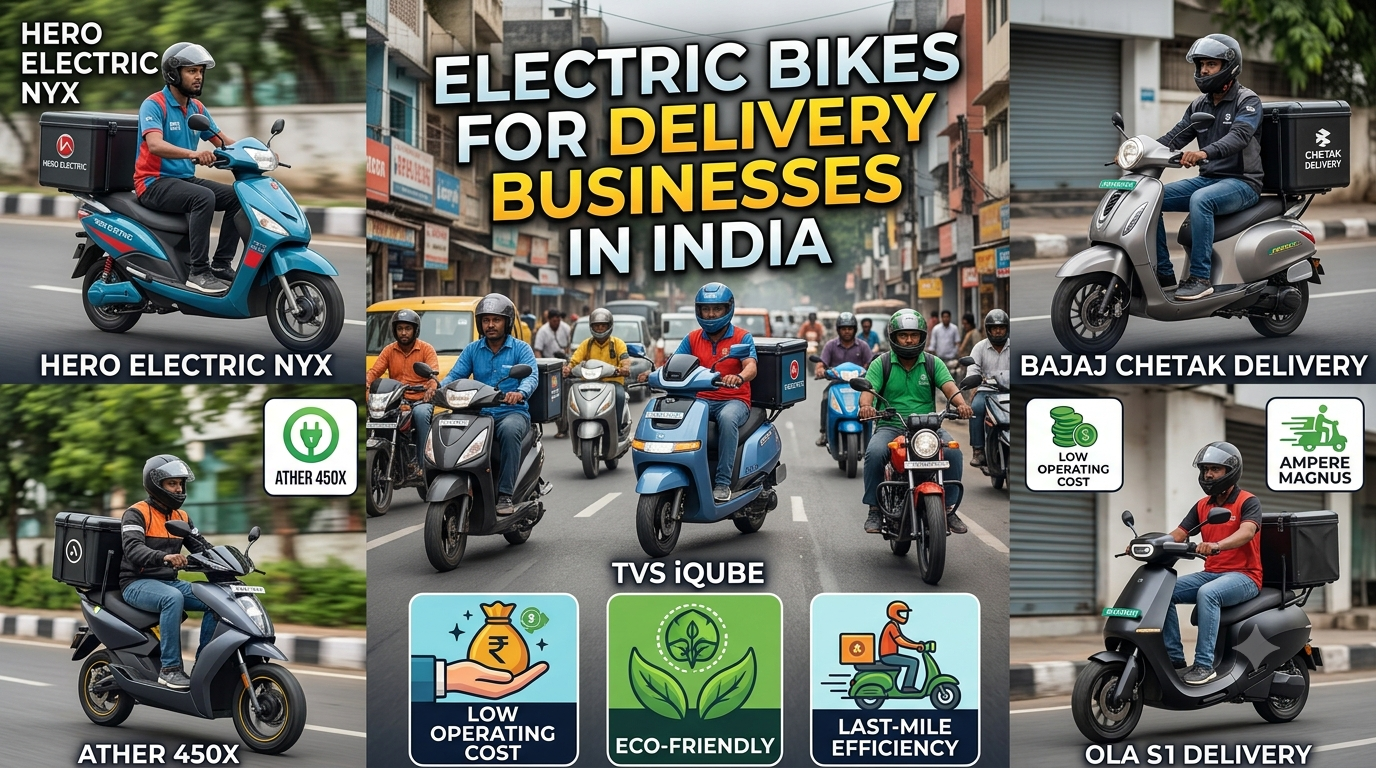
One would assume that switching over to electric bikes would reduce costs a bit. In reality, the total cost of running a fleet of delivery bikes has changed completely. The primary reason for switching to electric bikes is financial, with the secondary reason being environmental. If you are looking to incorporate electric bikes for delivery in India or looking for the best delivery e-bikes, then the costs should be very easy to justify.
Comparing Daily Costs of Petrol Bike and Electric Scooter
| Cost Item | Petrol Bike (100cc) | Electric Scooter |
|---|---|---|
| Fuel/Charging Cost (Rs. per day) | 160 - 200 | 25 - 35 |
| Monthly Fuel (Rs.) | 4,800 - 6,000 | 750 - 1,050 |
| Maintenance (Rs./month) | 500 - 1,000 | 100 - 200 |
| Total Monthly Savings (Rs.) | - | Rs.4,150 - 5,750 |
For a fleet of ten bikes, the savings is Rs. 40,000 - 57,500 every month. This is not small money; it is a significant profit that is wasted every month at the petrol pump.
Total Cost of Ownership in 3 Years - The Complete Picture
| Cost Item | Petrol Bike | Electric Bike |
|---|---|---|
| Purchase Price | Rs.65,000 | Rs.85,000 - 1,10,000 |
| FAME II or State Subsidy | Rs.0 | Rs.10,000 - 25,000 |
| Net Cost After Subsidy | Rs.65,000 | Rs.60,000 - 85,000 |
| 3 Years Fuel or Charging Cost | Rs.1,74,000 | Rs.27,000 |
| 3 Years Maintenance | Rs.27,000 | Rs.7,200 |
| 3 Years Saving Versus Petrol | Rs.0 | Rs.1,46,800 - 1,71,800 |
| Total 3 Years Ownership Cost | Rs.2,66,000 | Rs.94,200 - 1,19,200 |
Electric Bikes are costlier to buy, but after the subsidy, the costs are closer than they appear. The cost of a petrol bike will justify the purchase at the cheaper running costs in 12 to 18 months, but Electric Bikes will then have a far cheaper cost to operate.
Businesses looking to reduce delivery expenses can consider electric bike rentals as a flexible alternative to purchasing an entire fleet. Rental options can help businesses test electric vehicles, reduce upfront investment, and support efficient last-mile delivery operations.
Before switching an entire delivery fleet to electric vehicles, businesses should compare the running costs, maintenance requirements, and long-term savings of both options. A detailed gasoline vs. electric bikes comparison can help fleet operators understand which option is more suitable for their delivery requirements.
Better Electric Delivery Options
Swappable Battery vs. Plug-in Battery - Which Is Better for Delivery?
Swappable (Bounce Infinity, Gogoro network)
Plug-in (Ather, TVS iQube, Hero Electric)
In most Indian cities, overnight plugging at a depot is the more practical option. Rapid battery charging infrastructure has a long way to go, and rural areas and Tier 2 cities are more dependent on plugging infrastructure for the time being.
What Subsidies Will Be Available in 2025-26?
Check current policy as state schemes frequently change. Looking up policies from six months ago is not useful.
A Practical Approach to Transitioning to an Electric Fleet
The most common method to transitioning a fleet to EVs is doing it in small stages. The following steps outline this method.
Use ONNBikes to Lease Your Delivery Fleet
ONNBikes enables businesses to operate commercial delivery fleet EVs through monthly leases and without the capital cost and balance sheet impact of a large fleet purchase. Currently operating in Bangalore, Hyderabad and Pune with plans to add more.
Lease your electric delivery fleet with ONNBikes, with a simple booking process and no deposit or other time consuming procedures.
Businesses looking to reduce delivery costs can benefit from electric bike rentals. Electric bikes provide an affordable, eco-friendly, and efficient solution for faster last-mile deliveries while helping businesses lower operating costs.
Not sure whether electric bikes are the right choice for your fleet? Read Gasoline vs. Electric Bikes to understand the long-term cost, efficiency, and environmental benefits of switching to EVs.
Common Questions
Q1: Are electric bikes reliable enough to be used for 100km of delivery trips in a day?
A1: Some electric bikes like the TVS iQube and Ather 450s have real world ranges of 145km and 115km, respectively, and can accomplish the 100km round trip easily. There are also electric bikes like the Bounce Infinity E1 that have swappable batteries that eliminate range concerns, as riders can swap batteries mid shift. The actual reliability of electric bikes is less of a concern and more the charging infrastructure that can be inadequate in some of the smaller towns.
Q2: How much do you expect to save in your delivery operations by switching to electric?
A2: You can save an estimated 4,000-5,700 rupees in fuel and maintenance each month for each delivery bike making the round trip of 100km. Savings over 3 years, even accounting for the investment in the electric bike, are between 1.4-1.7 lakh rupees for each delivery bike. If you switch 10 delivery bikes to electric, that is a savings of approximately 14-17 lakh rupees in 3 years.
Q3: Can I lease electric bikes for my delivery operation from ONNBikes?
A3: Yes, you can lease electric delivery bikes from ONNBikes for a month. This is offered in Bangalore, Hyderabad, and Pune. This is a good option for delivery operators that would like to test the delivery operations using electric bikes, but would like to avoid a capital investment in a fleet of bikes. Check ONNbikes.com to find more details on fleet leasing.
Was this helpful?