

Save Big with Monthly Bookings!Save big with a monthly booking and ride worry-free all month long!
Explore Now
Pravin is a travel experience writer and a professional web developer passionate about making meaningful digital experiences. When not at work, he enjoys exploring new locations and sharing those experiences through story telling and writing. His passion for telling stories enables him to engage with people more deeply, fusing creativity and technology in all he does. Pravin wants to encourage people to travel, accept different viewpoints, and share their own special tales via his writing and art.
Summary:
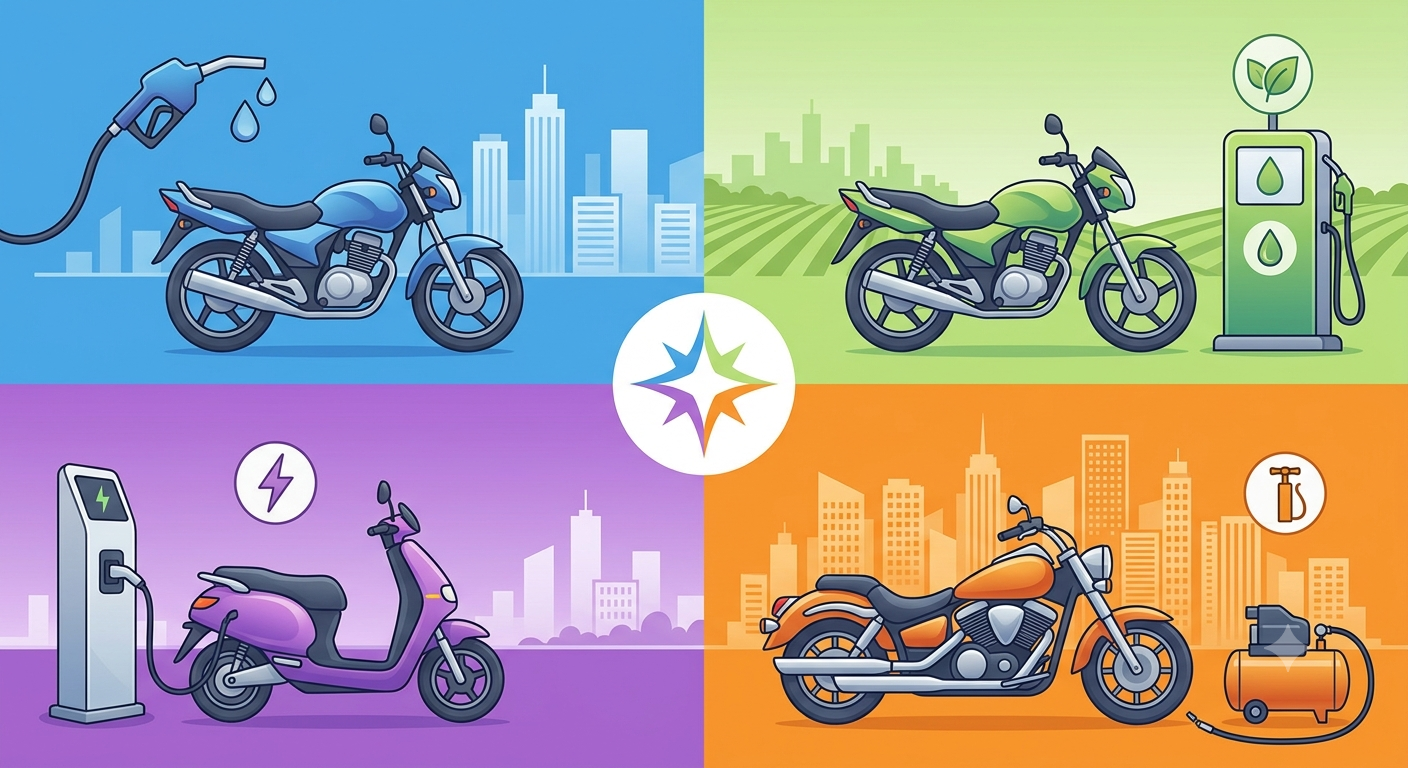
Most riders consider fuel twice - when the reserve light comes on and when they wince at the price after filling up. In 2025-26, the fuel going into your bike matters more than in previous years, even more than riders realize. Knowing the fuel choices available when buying your bike in India can save you the expense of a new bike in the long run, protect your engine, and even change the bike you want to buy next. Currently available options for your bike fuel in India consist of petrol grades, ethanol blends, CNG two-wheelers, and a practical electric segment. This will give you a good sense of what's available.
For the most part, regular petrol works for the average commuter bike. Only high-compression engines need petrol of a higher grade. Current E20 ethanol blend petrol slightly reduces mileage, but costs less overall. For commuter bikes that regularly travel a high mileage in a day, CNG may be the better fuel option if infrastructure supports it. Electric for a commuter bike that travels a daily city range can now be a cheaper overall option. For the most part, which bike fuel and bike option is best for you depends on how far you travel in a day and where you travel. See the use-case guide below.
Petrol - The Reigning Fuel
Petrol is the fuel of choice for over 90% of India's two wheelers, but it comes in different grades. The two most common grades are:
| Fuel Type | Octane | Price (Rs/ltr) | Recommended For |
|---|---|---|---|
| Regular Petrol | 87 | 97 - 105 | BS4 bikes, commuter bikes, low compression |
| Speed / Power Petrol | 91 - 97 | 105 - 120 | BS6 Royal Enfield, BS6 KTM, high compression |
For the average commuter bike like the Splendor and scooters like the Activa and Shine, any regular petrol from an authorized pump is perfectly fine. The difference in petrol grades marginally benefits high compression engines, but the price is typically not worth it for the average rider.
Pros - Regular petrol is the most widely available fuel in the country and works in all existing petrol engines with no compatibility issues.
Cons - It is the most expensive fuel in terms of cost per kilometer and is the most affected by oil price fluctuations.
BS6 Engines - Fuel Grade Matters More
All bikes sold in India after April 2020 are BS6 compliant. While the previous BS4 engines operated with carburetors, BS6 engines are fitted with fuel injection systems. Fuel corruption is now more of a concern with BS6 engines. Adulterated petrol can damage the fuel injector and negatively impact fuel economy while bringing up the engine warning indicator.
E10, E20 and Ethanol Blends
India has been progressively adding ethanol to fuel implementing energy policy. E10 (10% Ethanol and 90% Petrol) is what's at most fuel stations. E20 (20% Ethanol) is rolling out in stages nationwide.
Pros: E20 is a little cheaper, lowers emissions, and riding habits remain the same.
Cons: small impact on mileage, and older bikes that aren't rated for E20 will see rubber seals degrade faster over time.
CNG Two Wheelers
The Freedom 125 was released in 2024 by Bajaj, and is India's first CNG motorcycle. The appeal for commuters is strong because it is about Rs. 1 per kilometer compared to the per kilometer cost of petrol of Rs. 2.5-3.
Pros: lowest running cost (compared to other fuels besides electric), and the backup petrol tank basically eliminates range anxiety. Cons: limited model options, petrol CNG infrastructure limited to a handful of metro cities, and the CNG cylinders are heavy and decrease storage.
Electric - No Longer Just Something to Consider in Theory
| Model | Real Range | Charge Time | Running Cost per km | Price |
|---|---|---|---|---|
| Ola S1 Pro | ~165 km | 6.5 hours | Rs.0.25 | Rs.1.3 lakh |
| Ather 450X | ~130 km | 5.5 hours | Rs.0.30 | Rs.1.4 lakh |
| TVS iQube ST | ~130 km | 5 hours | Rs.0.28 | Rs.1.1 lakh |
| Bajaj Chetak | ~105 km | 5 hours | Rs.0.22 | Rs.1.1 lakh |
| Hero Vida V1 Pro | ~140 km | 5 hours | Rs.0.25 | Rs.1.2 lakh |
Within a range of 60-70km of city driving, the economics of going electric are compelling. The running cost of going electric is 8-10 times lower than petrol and maintenance is less of a concern since there are no oil changes and no fuel filters or exhaust systems.
Pros: lowest running cost of any fuel type, minimal maintenance with no oil changes or exhaust servicing, and zero tailpipe emissions.
Cons: limited real-world range compared to petrol, charging infrastructure is still patchy outside major cities, and charging takes hours rather than the minutes needed for a petrol refill.
Types of Batteries and Charging
Ather and TVS scooters carry Lithium-ion Phosphate (LFP) batteries and scooters with Lithium-ion Nickel Manganese Cobalt (NMC) batteries charge quicker, and have a better range, but don't tolerate the heat or daily fast charging as well as LFP batteries.
A 5A or 15A home socket is enough to get most scooters charged overnight. Complete charging the battery from empty usually takes between 5 and 6.5 hours.
Fast charging is required to get Ather's grid and a couple of other chargers to 80% charge in an hour.
Manufacturers usually warranty batteries for 3 years or between 30,000 to 50,000 km. Expect a slow decline in range after this period.
Choosing for Your Usage
If you only do a short city commute (less than 40 km a day), and have access to home charging, the Electric scooter has the clear advantage with the lowest running costs, and the lowest maintenance costs.
If you do high mileage in a city covered by a CNG network, CNG should also have a similar cost as Electric with a perhaps, easier to find model.
If you do a mix of city and highway driving, or long distance driving, Petrol remains the best choice for range and the ease of refueling.
If you are looking for performance or touring bikes in the Royal Enfield or KTM range, you have no choice but to go with Premium Petrol.
A Quick Comparison Across All Fuel Types
| Metric | Petrol | CNG | Electric | E20 |
|---|---|---|---|---|
| Cost per km | Rs.2.5 - 3 | Rs.1 - 1.2 | Rs.0.25 - 0.30 | Rs.2.7 - 3.2 |
| Typical Range | 300 - 500 km | 200 - 300 km | 100 - 165 km | 280 - 470 km |
| Maintenance Demand | Moderate | Low | Very low | Moderate |
| Infrastructure in India | Excellent | Limited to major cities | Growing steadily | Excellent |
| Best Suited To | All routes | City only | City and suburbs | All routes |
Want to try an electric or CNG bike before committing? We have scooters starting at Rs.300/day and bikes at Rs.500/day in Bangalore, Hyderabad and more, or choose an electric model for testing in select cities. No deposit, no papers. Just book and go.
Questions People Usually Have
Q: Which petrol grade should I be using for my BS6 bike?
A: 87 octane from any authorized pump is totally fine for regular BS6 bikes. For performance bikes with higher compression like KTM Duke, Royal Enfield 450, Yamaha R15 V4, 91+ octane may help with a bit of extra mileage and performance.
Q: Does E20 petrol damage bike engines?
A: Only in case your bike is not E20-compatible, which most BS6 are. Better check the owner's manual in case of doubt. Not E20-compatible bikes will see a loss of performance and mileage with regular E20 petrol.
Q: Are electric scooters a practical option for daily commuting in Indian cities?
A: Cities that have better charging station coverage, electric scooters make commuting practical when distances are under 80km a day. Their running cost is Rs.0.25-0.30 per km, while petrol costs Rs.2.5-3. You can rent electric scooters through ONNBikes in Bangalore, Hyderabad, and Pune if you wish to test one out before making a purchase.
Was this helpful?