

Save Big with Monthly Bookings!Save big with a monthly booking and ride worry-free all month long!
Explore Now
Pravin is a travel experience writer and a professional web developer passionate about making meaningful digital experiences. When not at work, he enjoys exploring new locations and sharing those experiences through story telling and writing. His passion for telling stories enables him to engage with people more deeply, fusing creativity and technology in all he does. Pravin wants to encourage people to travel, accept different viewpoints, and share their own special tales via his writing and art.
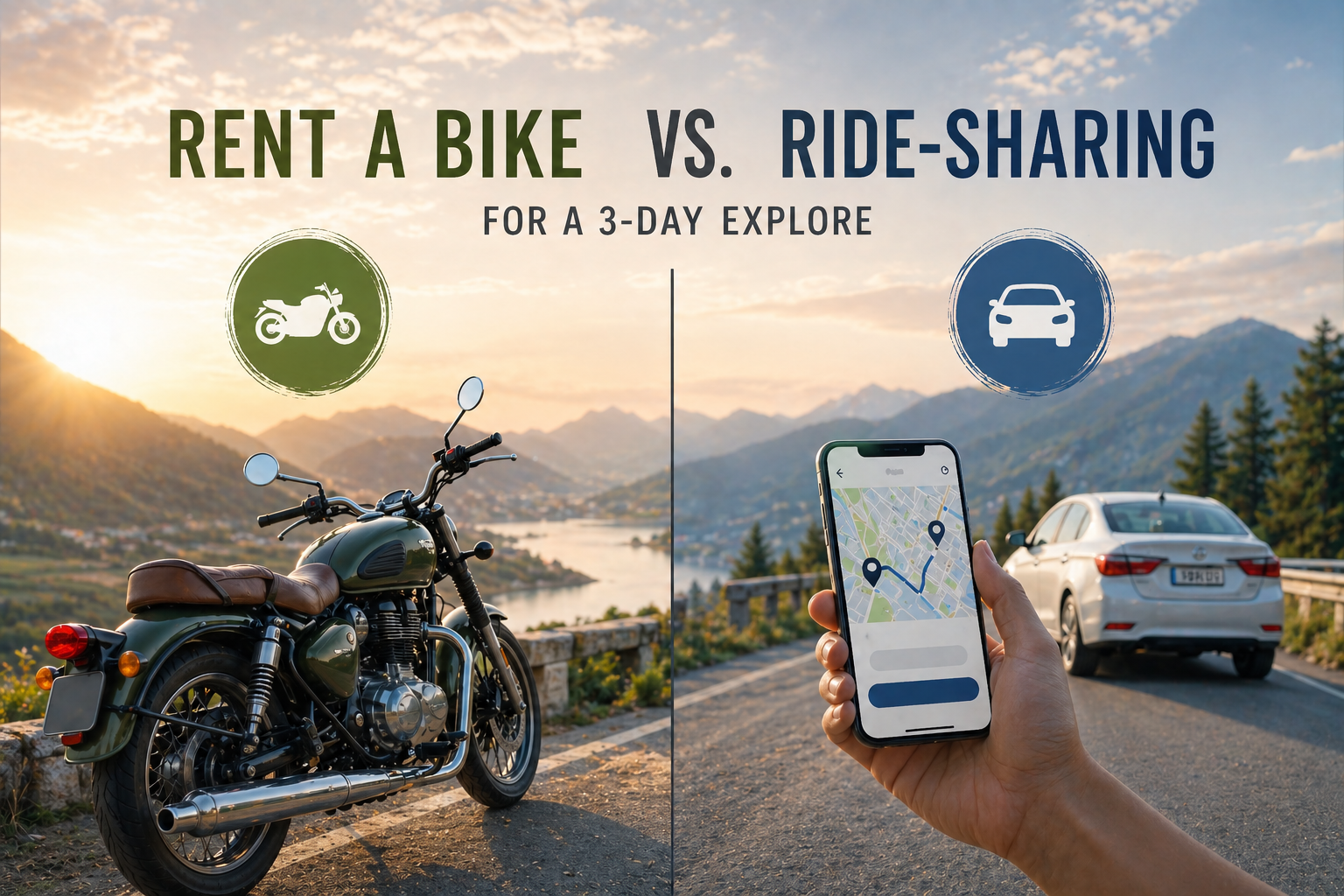
A 3-day city exploration can cost nearly twice as much with ride-sharing compared to renting a bike. While apps offer convenience, bike rentals provide greater freedom, flexibility, and significant savings—making them the smarter choice for travelers who want to truly explore.
Comparing costs between bike rentals and ride-sharing shows that renting a bike is often more affordable for multi-day trips, with daily rentals starting as low as ₹119 while ride-sharing fares can quickly add up per trip, making a bike rental in Pune a budget-friendly choice.
Modern travel isn't just about checking boxes on a TripAdvisor list anymore. It’s about the vibe, the "wrong" turns that lead to the best cafes, and the freedom to stay at a sunset spot for just ten minutes longer.
In cities like Pune, Bangalore, or Hyderabad, your mobility dictates your mood. Usually, it comes down to two choices: the reliability of ride-sharing apps or the grit and freedom of a rental bike. When you’re looking at a 3-day exploration, the price gap between these two isn't just pocket change—it’s "fancy dinner" money.
The Game Plan: 72 Hours of Exploration
Let’s imagine you’re hitting a new city for a long weekend. Your itinerary looks something like this:
Total distance? Roughly 120–150 km i.e. 40-50 kms each day. Here’s how the math actually shakes out.
Option 1: The Ride-Sharing Routine
We’ve all been there: staring at the "Finding your ride" screen. It’s easy, it’s air-conditioned, and you don’t have to worry about parking. But the "convenience tax" adds up fast.
The Math of the App:
The Reality Check:
That ₹2,700 is a "best-case scenario." Once you factor in peak-hour surges, rain delays, or that one driver who cancels three times, most travelers end up spending closer to ₹3,500. Plus, every time you want to make a quick stop for a photo, the meter (or your patience) is running.
Option 2: The Rental Bike Route
Renting a bike is the "local" way to travel. It’s become a go-to for savvy travelers because it turns a commute into an adventure.
The Math of the Machine:
The Verdict:
You’re saving nearly ₹1,800. That’s enough to cover your entry tickets, a few rounds of specialty coffee, or a really nice souvenir you actually want.
The "Vibe" Factor: Why Renting Wins
Beyond the bank account, there are things an app just can't give you:
When to Stick to the App
Look, renting a bike isn't for every situation. Stick to ride-sharing if:
The Pro-Traveler Hybrid
Many veterans use a split strategy: Rent a bike for the daytime hustle and the scenic highway runs, then use a ride-share for dinner and drinks at night so you don't have to worry about driving back to the hotel.
The Bottom Line
If you want to just "get there," call a cab. But if you want to explore, rent a bike. Services like ONN Bikes have made it so easy to grab a key and go that there’s really no excuse not to.
After all, the best parts of a trip aren't usually the landmarks you pinned on a map—they’re the moments you stumbled upon because you had the freedom to turn the handlebars.
For a 3-day explore, having your own ride gives better flexibility and cost control compared to repeated bookings, especially when you plan efficiently using a bike rental step-by-step guide.
Was this helpful?