

Save Big with Monthly Bookings!Save big with a monthly booking and ride worry-free all month long!
Explore Now
Pravin is a travel experience writer and a professional web developer passionate about making meaningful digital experiences. When not at work, he enjoys exploring new locations and sharing those experiences through story telling and writing. His passion for telling stories enables him to engage with people more deeply, fusing creativity and technology in all he does. Pravin wants to encourage people to travel, accept different viewpoints, and share their own special tales via his writing and art.
Summary
Responsible biking goes beyond choosing two wheels—it’s about riding smoothly, maintaining your machine, reducing waste, and respecting nature. Small habits like proper maintenance, mindful riding, and sustainable gear choices help riders minimise their environmental impact while preserving the roads they love.
Being a responsible biker means reducing your environmental impact by choosing sustainable travel options, as bikes produce zero emissions and significantly cut down air pollution compared to cars, making it easier to ride consciously with a bike rental in Coimbatore.
The Silent Roar of the Conscious Rider
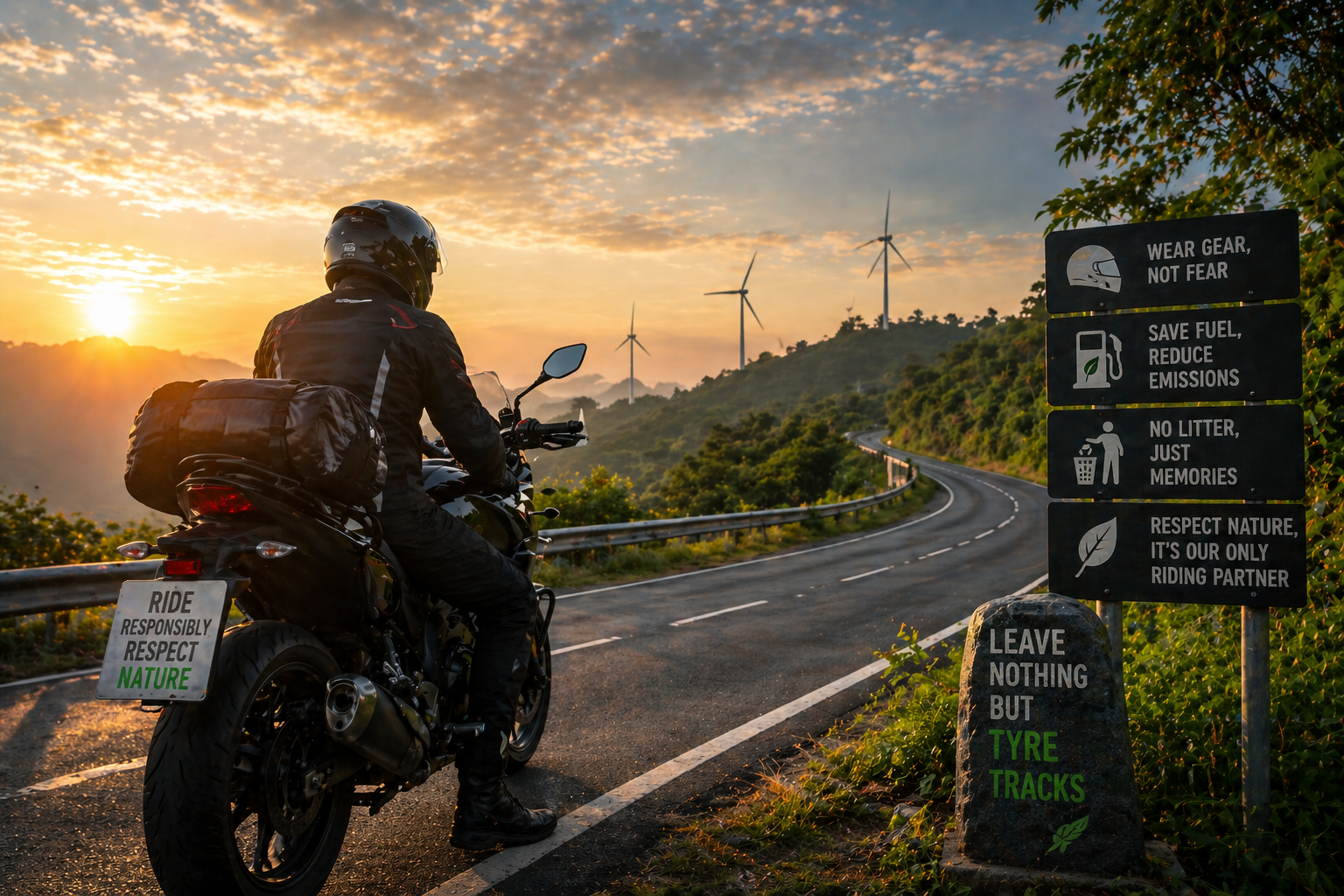
Picture this: a crisp morning. A winding road cutting through a forest still damp with dew. The quiet hum of your engine is the only thing disturbing the silence. The air smells clean. The trail behind you holds nothing but a faint tyre mark.
That’s the kind of ride every conscious biker dreams of. And the good news? It’s far more achievable than most riders think.
Yes, motorcycles already have a smaller footprint than cars. While a mid-sized sedan emits roughly 120–180 grams of CO₂ per kilometre, a modern 150cc motorcycle produces about 60–80 grams — often less than half. But being a responsible biker isn’t just about choosing two wheels over four. It’s about how you ride; It is about -
How you maintain your machine.
What you buy.
What you refuse.
What you leave behind.
This is where ONN Bikes fits naturally into the picture. Bike rentals and sharing models are part of a circular economy — one well-maintained motorcycle serving many riders instead of dozens sitting idle. Fewer vehicles manufactured. Fewer resources consumed. Less waste generated.
When you rent instead of own, you’re already making a smarter choice.
Here’s how to take it further.
1. The Machine: Maintenance Is Environmentalism
A poorly maintained bike isn’t just inefficient — it’s polluting more than it should. When an engine isn’t tuned properly, it burns fuel incompletely. That means more hydrocarbons, more carbon monoxide, and more particulate matter entering the air you ride through. Taking care of your motorcycle is one of the simplest environmental actions you can take.
2. Tyre Pressure
Under-inflated tyres increase rolling resistance, forcing the engine to work harder. Just 10 PSI below the recommended level can reduce fuel efficiency by 3–5%.
A weekly pressure check takes two minutes. It saves fuel, improves safety, and extends tyre life.
And remember: choosing durable tyres and maintaining correct pressure reduces how many end up in landfills — or worse, illegally burned.
3. Air Filters & Spark Plugs
A clogged air filter disrupts the fuel-air mixture your engine depends on. Replace or clean it every 5,000–10,000 km.
Worn spark plugs cause incomplete combustion and misfires. Replacing them on schedule improves performance and reduces emissions. Small parts. Big difference.
4. Oil Disposal
Used engine oil is a hazardous waste. One litre can contaminate up to one million litres of groundwater. Never dump it on soil or into drains. Use authorised service centres or certified recyclers. Responsible disposal matters more than most riders realise.
5. Riding Habits: The Green Throttle
Two identical bikes. Same route. Same distance.
Different riders.
Very different emissions.
Your throttle control has a direct environmental impact.
Smooth Over Aggressive
Hard acceleration followed by sharp braking burns more fuel and wears down brake pads faster. That dust from brake wear? It doesn’t just disappear — it becomes airborne pollution.
Ride smoothly. Anticipate traffic. Flow with the road instead of fighting it.
Find the Sweet Spot
Most 100–200cc bikes are most fuel-efficient between 3,000–5,000 RPM. Revving unnecessarily high wastes fuel. Shift up early. Use higher gears at steady speeds when possible.
Your engine doesn’t need to scream to prove a point.
The 30-Second Rule
If you’re stopped for more than 30 seconds — at a signal or railway crossing — switch off the engine. An idling 150cc bike consumes roughly 0.3–0.5 litres per hour while going nowhere. It’s a small habit that makes a surprisingly large difference when multiplied across thousands of riders.
6. Myth-Busting: “Loud Pipes Save Lives”
The belief: Modified exhausts make you safer.
The reality: Most exhaust noise projects backward, not forward toward approaching cars. Studies consistently show that high-visibility gear — reflective vests, bright jackets — is far more effective for safety.
Meanwhile, excessive exhaust noise contributes to urban stress, disturbs wildlife, and disrupts communities.
Gear & Lifestyle: It Doesn’t Stop at the Bike
Sustainable riding extends beyond the engine.
Choose Better Gear: Today, many riding brands offer jackets made from recycled PET materials, vegan leathers, and more sustainable manufacturing processes. When upgrading, look beyond price. Look at lifespan.
The Longevity Mindset: A cheap jacket replaced every two years costs the planet more than a premium one that lasts ten. Sustainability often looks like buying once — and buying well.
Plastic-Free Touring: On long rides, it’s easy to collect single-use plastic bottles. Instead, carry a reusable hydration pack or steel bottle. Refuse unnecessary plastic bags at roadside stops.
Leave destinations better than you found them.
The Electric Shift
If there’s one change that truly alters the equation, it’s electrification.
Electric scooters produce zero tailpipe emissions — no CO₂, no NOx, no particulates. In cities where two-wheelers significantly contribute to air pollution, this matters enormously.
They’re quieter too. That reduces noise pollution in dense urban corridors where sound levels regularly exceed safe limits.
And the economics? Charging costs a fraction of petrol. With fewer moving parts, maintenance is lower as well.
Not sure if electric suits your style? Renting one is the simplest way to experiment without commitment. A short-term EV rental from ONN bikes lets you experience the instant torque, smooth acceleration, and near-silent commute firsthand.
Sometimes sustainability just feels… good.
Respecting the Terrain
Adventure doesn’t mean destruction.
Stay on Designated Paths: Off-roading through forests and riverbanks compacts soil, damages roots, and accelerates erosion. Trails exist for a reason. Respect them.
Protect Wildlife & Communities: Excessive noise disrupts animal communication and disturbs local residents. Responsible riding preserves both nature and goodwill.
The road isn’t just yours. It’s shared.
Your Legacy on Two Wheels
Sustainability isn’t about perfection.
It’s about better decisions — repeated consistently.
Check tyre pressure.
Carry a reusable bottle.
Ride smoothly.
Try electric.
Each small action is a vote for the kind of roads you want to keep riding for decades.
The goal isn’t guilt. It’s awareness.
And maybe this is what being a responsible biker truly means:
Enjoying the freedom of the road — without taking more from it than you give back.
Adopting eco-friendly riding habits like fuel-efficient trips and mindful travel helps protect the environment while enhancing your journey, especially when you learn practical tips from a gasoline vs electric bike comparison guide.
Was this helpful?